Best Places to Visit in Greece: 5 Picks for Every Traveler
Crete, Santorini, Athens, Naxos or Meteora? A practical guide to the best places to visit in Greece, matched to your time, budget and travel style.
The Short Answer
Greece is not one destination. A week on Crete, three nights on Santorini and two days in Athens are three completely different trips, and the right pick depends on how long you have, whether you want to keep moving, and whether you would rather swim or stand in front of a ruin.
The short version: Crete is the best all-around choice for a first long trip, Santorini wins if the caldera view is the whole point, Athens is unmissable for ancient history, Naxos is the best island for beaches without the crush, and Meteora is the one mainland detour worth rebuilding an itinerary around.
Island Picks: Crete, Santorini and Naxos
These three islands cover the range: one big enough to feel like a country, one that is essentially a view, and one that quietly does beaches better than either of them.
Best overall
Crete
4.8Crete covers the most ground with the fewest compromises. It is big enough to hold three separate trips: the west around Chania and Rethymno, with the Venetian harbor, the Samaria Gorge and the lagoon at Balos; the center around Heraklion, Knossos and the wine country inland; and the quieter east around Agios Nikolaos and Vai.
The food alone justifies the journey — mountain greens, sheep's cheese, snails, raki and olive oil — and inland villages stay genuinely lived-in even in August. You want a car: the best beaches and tavernas sit at the end of unsigned roads rather than beside the port.
Give it a week minimum, two if you want both hiking and beach time.
Why it works
- Range no single island can match: Minoan ruins, gorges, palm beaches and mountain villages
- One of the richest food cultures in Greece, from Chania's market to village tavernas
- Long season — spring and fall are ideal for walking and the sea stays swimmable into October
- Large enough to absorb crowds; a quiet stretch is always reachable
What to know
- Distances are real; without a rental car you are stuck near your base
- Parts of the north coast are built up with package hotels
- July and August heat makes midday hiking and sightseeing hard
Best for the iconic view
Santorini
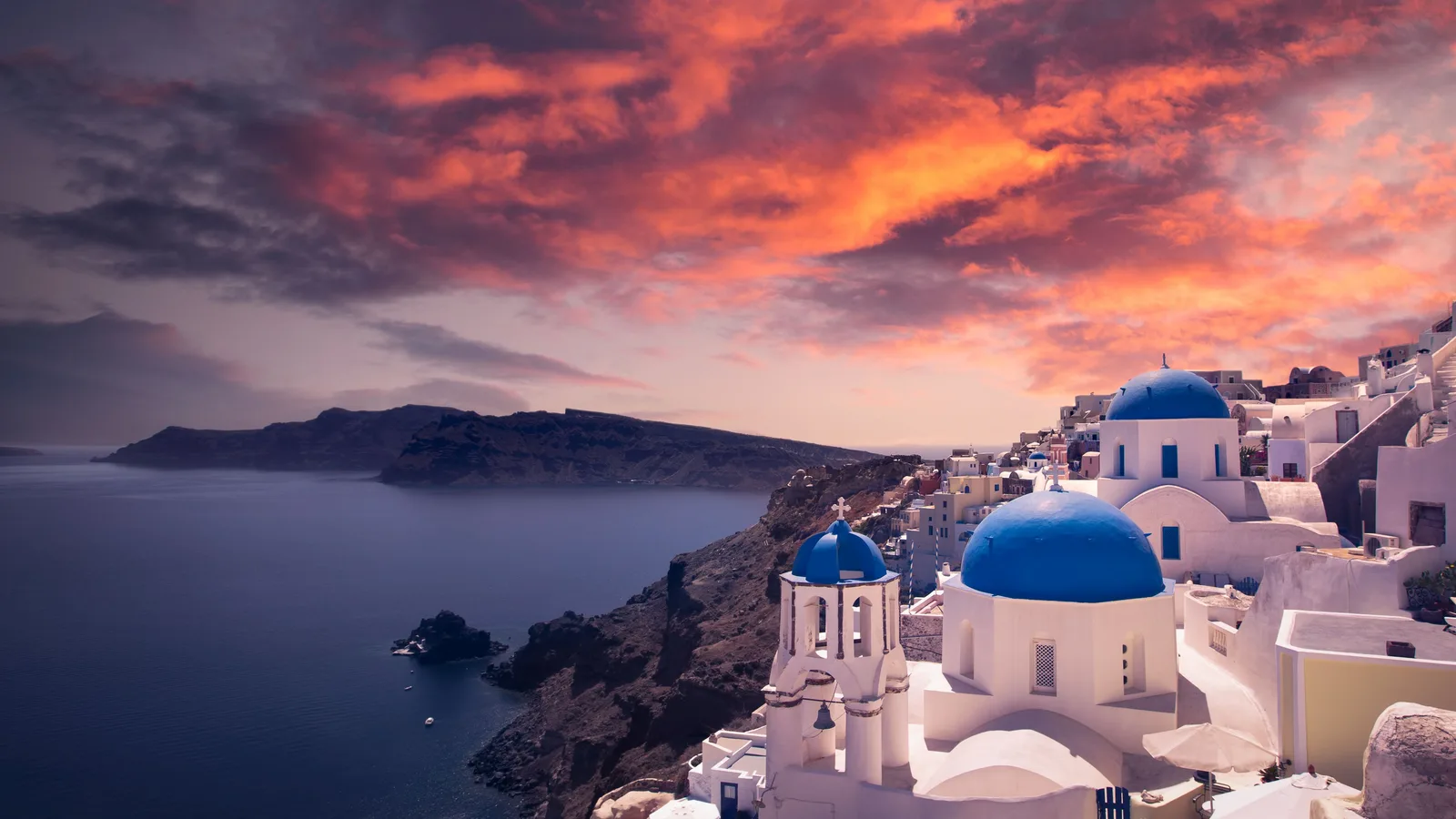
4.2The caldera earns the hype: whitewashed villages stacked on a cliff above the volcano islands, with the best of it on the rim walk between Fira and Oia. Imerovigli and Pyrgos give you the same views with a fraction of the foot traffic.
Beyond the postcard, Santorini has the Bronze Age town of Akrotiri, volcanic vineyards around Pyrgos producing Assyrtiko and the sweet Vinsanto, and black and red sand beaches at Kamari, Perissa and Vlychada.
Plan two to three nights. Cruise ships empty into Fira and Oia around midday, and the sunset crowd in Oia is a scrum — watch it from Imerovigli or from a caldera-facing room instead.
Why it works
- The most dramatic setting in the Aegean, and the Fira to Oia walk is unforgettable
- Serious wine country: Assyrtiko and Vinsanto from volcanic soil
- Compact — buses, taxis and short drives cover the whole island
- In April, May and October it is calm, warm and far cheaper
What to know
- Prices and crowds peak in July and August; Oia at sunset is shoulder to shoulder
- Volcanic beaches are striking but not the soft sand you get on Naxos
- Caldera-view rooms are among the most expensive stays in Greece
Best island for beaches and value
Naxos
4.5Naxos is the Cyclades without the performance. The main town has the Portara, a giant marble doorway from an unfinished temple of Apollo, plus a Venetian kastro and a working waterfront; inland, olive terraces climb toward Mount Zas, the highest point in the Cyclades.
The southwest coast is one long run of sand — Agios Prokopios, Agia Anna, Plaka and Mikri Vigla, the last a windsurfing and kitesurfing spot. Villages like Apiranthos and Halki, and the unfinished kouros statues near Melanes and Apollonas, fill a hot afternoon or a windy day.
Ferries from Piraeus and easy hops to Paros and Santorini make it a natural middle stop on an island-hopping route.
Why it works
- Some of the best sandy beaches in Greece, with room to spread out
- Noticeably better value than Santorini or Mykonos for rooms and food
- Real inland life: mountain villages, local cheese, potatoes and kitron liqueur
- Simple ferry links to Paros, Ios and Santorini
What to know
- Fewer headline sights than Crete or Athens; it is a beach-and-village island
- The port town is functional rather than beautiful
- You will want a car or scooter for the best beaches and villages
Mainland Picks: Athens and Meteora
The mainland is where Greek history and geography are most concentrated. Athens is the obvious starting point; Meteora is the reason to leave the coast behind.
Best for ancient history
Athens
4.4Athens has the densest concentration of visible history in the country. The Acropolis and Parthenon sit above the city, the Acropolis Museum below them holds the finds, and the Ancient Agora, Kerameikos and the National Archaeological Museum easily fill two or three days of proper sightseeing.
The city itself deserves the time: Plaka and Anafiotika under the rock, the Monastiraki flea market, the food streets around Varvakeios market, and a strong modern restaurant and bar scene in Koukaki and Exarchia.
Treat it as a base, not a transit stop. Cape Sounion, Delphi and the island of Aegina are all feasible day trips, and the airport metro drops you downtown in well under an hour.
Why it works
- Acropolis, Acropolis Museum and the Agora in one walkable core
- The best food and nightlife of any Greek city, at local prices
- Excellent transport: airport metro, coastal tram, ferries from Piraeus
- A year-round city that does not shut down in winter
What to know
- Summer heat and traffic make midday sightseeing tough
- Grittier and noisier than the islands; there is no beach here
- The sprawl punishes poor planning — pick a central base and a route
Best for mainland scenery
Meteora
4.6Meteora does not feel like a beach holiday at all, which is exactly the point. Byzantine monasteries sit on top of sandstone pillars above Kalambaka, reached by stone steps cut into the rock. Six are still active, including the Great Meteoron, Varlaam and Rousanou, and each keeps its own opening days and hours.
Base in Kastraki for the walking — trails link the monasteries through oak woods — or in Kalambaka for the train. Sunrise and sunset from the rocks are why photographers keep returning, and the whole area is a UNESCO World Heritage site.
One full day covers the main monasteries; two lets you hike and add the Byzantine church in Kalambaka. It pairs naturally with Delphi on the loop back to Athens.
Why it works
- Scenery unlike anywhere else in Greece
- Active monasteries you can actually enter, with a dress code enforced at the door
- Good hiking between the pillars from spring through fall
- Easy to combine with Delphi or the Zagori villages
What to know
- No sea and no beaches; it is a two-day cultural stop rather than a holiday
- Monastery opening days vary and can catch you out
- Steps are steep and slippery in rain, and access is limited for anyone with mobility issues
Side by Side: How the Five Compare
| What to weigh | Crete | Santorini | Naxos |
|---|---|---|---|
| Best for | Variety: beaches, mountains, food and ruins in one trip | Caldera views, sunsets and volcanic wine | Long sandy beaches and relaxed value |
| Time to do it justice | 7 to 14 days | 2 to 4 nights | 4 to 7 days |
| Getting around | A rental car is close to essential | Buses, taxis and short drives between villages | Car or scooter for beaches, buses for the main spots |
| Beach style | Coves, lagoons and long stretches, some remote | Volcanic pebbles and black sand | Wide sand with shallow entries, plus windsurfing spots |
| Crowd level | Busy in July and August but easy to escape | Very busy at sunset and when cruise ships are in | Busy port town, calm along the south coast |
| Food and drink | Deep regional cooking, mountain herbs, olive oil | Wine-led, with Assyrtiko and Vinsanto | Tavernas, local cheeses and kitron liqueur |
| What to weigh | Athens | Meteora |
|---|---|---|
| Best for | Ancient sites, museums and city food | Monasteries on rock pillars and hiking |
| Time needed | 2 to 3 days | 1 to 2 days |
| Getting there | Direct flights; metro from the airport to the center | Train or drive from Athens; base in Kalambaka or Kastraki |
| On foot | Long city days on marble and concrete | Steep stone steps and shaded woodland trails |
| Watch out for | Summer heat and traffic; choose a central base | Dress code at the monasteries and varying opening days |
How to Choose: The Criteria That Matter
Time of year decides more than you think. Late April through June, and September into October, give you warm sea, open archaeological sites and manageable crowds. July and August are hot, expensive and packed, especially on Santorini and around the Acropolis.
Count your moves. Every ferry or internal flight costs half a day. Two bases in a week is comfortable; four is a blur. Islands with airports, like Crete, Santorini and Naxos, save you the long sail back to Athens.
Be honest about what you are there for. Swimming and long lunches: Crete or Naxos. Ruins and museums: Athens, with Delphi or Meteora added. The photograph you have had on your wall for years: Santorini.
Budget island by island, not country-wide. Crete and Naxos sit in the mid-range; Santorini is the outlier, mostly because of caldera-view accommodation.
Plan around the crowds, not against them. Santorini in August and the Acropolis at noon are not relaxing. Both are far better in the shoulder season or first thing in the morning.
Putting a Trip Together
Seven days: Athens for two nights, then a ferry or short flight to Naxos for four, with a day trip to Paros.
Ten days: Athens for two, Santorini for three, Naxos for three, then back to Athens — or swap Santorini for western Crete if you would rather hike than pose.
Two weeks: Athens for two, Crete for six or seven split between Chania and the east, Santorini for two or three, and fly home from there.
Mainland only: Athens for three, Delphi for one, Meteora for two, and Thessaloniki if you have the days.
The Verdict
Frequently Asked Questions
Do I need to rent a car in Greece?
On Crete and Naxos, yes for the best beaches and villages — buses cover the main towns but not the good stuff in between. Athens has a metro that makes a car a liability, Santorini is small enough for buses and taxis, and Meteora is reachable by train with local taxis to the monasteries.
How many days do I need for a first trip to Greece?
Ten days to two weeks lets you pair Athens with two islands, or Athens with Meteora and one island. A single week is enough for one island done properly, and squeezing in three islands in seven days usually means spending the trip in transit.
When is the best time of year to visit?
Late April to June and September to October. The sea is warm, sites keep normal hours, ferries run and prices drop outside peak season. July and August bring intense heat and the heaviest crowds, particularly in the Cyclades.
Are Greek ferries reliable?
Mostly, yes. High-speed catamarans are more sensitive to wind than conventional ferries, and the summer meltemi can cause delays in the Cyclades. Book ahead in high season and never schedule a ferry arrival the same day as an international flight home.
Is Santorini still worth it if I dislike crowds?
Yes, if you stay in Imerovigli or Pyrgos rather than Oia, see the villages early in the morning, and travel in May, June or October. In peak August, with several cruise ships in port, the main viewpoints are genuinely uncomfortable.
Can I combine Meteora with a beach trip?
It works well as a two-day break between Athens and the north, or as a loop back to Athens via Delphi. From Kalambaka you can continue to Thessaloniki or the Zagori villages rather than backtracking to the coast.
Related articles
 The Best Carry-On Luggage: 5 Picks for Every TripShortlists
 Best City to Travel in Canada: 5 Picks for Every TravelerShortlists
 Best Crossbody Bags for Travel: 5 Picks Worth PackingShortlists
 The 5 Best December Travel DestinationsShortlists
 The 5 Best Places to Go in JanuaryShortlists
 Best Destinations to Visit in March: 5 Trips Worth PlanningShortlists
 Best Hiking Boots: 5 Picks for Trails, Backpacking and Wide FeetShortlists
 Best Island to Travel to in Hawaii: 5 Picks ComparedShortlists